
For more than a decade, the Dholera city project has been discussed with a mix of awe and deep skepticism. Early critics labeled it a paper city—a collection of ambitious blueprints, digital renderings, and master plans that would never break ground. If you invested money here in 2015, you likely watched your capital sit in silent, dusty fields while infrastructure crawled at a snail's pace.
But as we cross into mid-2026, the narrative surrounding the Dholera Special Investment Region (SIR) has fundamentally transformed. Ground-level execution has finally caught up with political rhetoric. The turning point did not come from residential plot sales; it came from massive, multi-billion-dollar heavy industrial anchors and structural logistics links that are now operational.
Whether you are a commercial real estate investor looking for multi-bagger returns, a retail brand seeking to anchor your supply chain, or a macro-economist tracking India’s semiconductor evolution, understanding the current state of Dholera is non-negotiable. This comprehensive guide strips away the marketing fluff to deliver an honest, data-backed assessment of what is actually happening on the ground in 2026, the real numbers, the hidden bottlenecks, and how to navigate this unique investment terrain safely.
What is the Dholera City Project?
Simple Definition
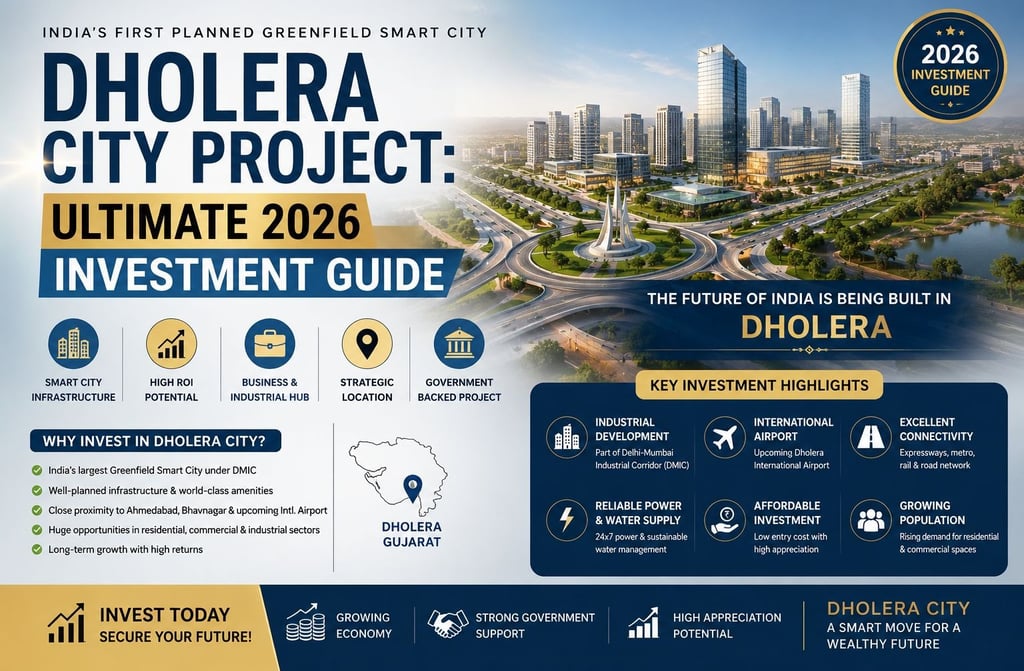
The Dholera city project is India's first greenfield smart city, built from the ground up across a massive 920 square kilometer area in Gujarat. Positioned as the foundational node of the Delhi-Mumbai Industrial Corridor (DMIC), it is designed to be a highly digitized, self-sustaining industrial and commercial superpower that is bigger than the physical footprint of Singapore or Mumbai.
How It Works
Unlike traditional cities that expand organically and chaotic fashion—leading to choked drainage, gridlocked traffic, and power deficits—Dholera operates on a linear zoning master plan. The government develops the "Trunk Infrastructure" first. This means roads, ICT (Information and Communications Technology) networks, industrial water lines, and automated waste systems are fully buried and operational before a single commercial building or house is constructed.
Development is tightly regulated by the Dholera Industrial City Development Limited (DICDL), a special purpose vehicle formed between the central government and the state government of Gujarat. The city uses a unique Town Planning (TP) Scheme model, where land owners pool their parcels, the government utilizes a percentage for public utilities and wide expressways, and returns developed, highly valued plots with precise boundary demarcations back to the owners.
Why It Matters in 2026 and Beyond
The year 2026 has become the defining launchpad for Dholera because the city has successfully transitioned from an "infrastructure planning phase" to an "operational and industrial execution phase."
The global restructuring of technology supply chains has turned Dholera into the epicenter of India’s semiconductor manufacturing ambitions. It is no longer just a real estate story; it is a critical geostrategic asset. For the next several decades, Dholera will serve as a live laboratory for high-tech manufacturing, zero-waste urban management, and automated logistics.
Key Features of the Dholera City Project
Feature One: The Semiconductor Fabrication Super-Ecosystem
The crown jewel of Dholera is the massive Activation Zone, which has evolved into a premier high-tech manufacturing base. Chief among these is the Tata Electronics semiconductor fabrication facility, built in partnership with Taiwan's PSMC. As of mid-2026, construction is roughly 50% complete, with trial productions slated to begin by the end of the year. Supported by global equipment giants like Tokyo Electron and supply chain partnerships with ASML, this single ecosystem is drawing billions in ancillary investments, including Fujifilm's semiconductor materials unit and Jabil’s Silicon Photonics facility.
Feature Two: The 250-Meter Wide Central Spine Road
Logistics cities live and die by their internal mobility. Dholera features a massive, multi-lane Central Spine Road that forms the structural backbone of the region. This highway is integrated with underground utility ducts, ensuring that maintenance crews never need to dig up the asphalt to fix a broken fiber optic cable or water line. It connects the industrial clusters directly to the external expressways, completely eliminating the first-mile bottleneck that plagues old industrial zones across India.
Feature Three: Total ICT Integration via the ABCD Building
The Administration and Business Centre of Dholera (ABCD) is the operational brain of the entire city. It houses a centralized command and control center powered by real-time IoT (Internet of Things) sensors spread across the smart city grid. From monitoring automated sewage treatment plants to optimizing street lighting and managing public safety, the entire urban ecosystem is run like a single, highly efficient software system.
Feature Four: World-Class Subsurface Smart Utilities
Walking down an active street in Dholera’s Activation Zone reveals an unexpected detail: there are zero overhead power lines, messy telecom wires, or open storm drains. Every single utility—including potable water lines, recycled industrial water networks, high-voltage electricity, and high-speed fiber—is routed through underground concrete trenches. The city also features a zero-liquid-discharge common effluent treatment plant to ensure zero industrial pollution reaches the surrounding environment.
Feature Five: The Renewable Energy Mega-Cluster
Dholera is built with sustainability as a foundational pillar rather than an afterthought. The region is flanked by a massive, multi-gigawatt solar park development spearheaded by Tata Power and ReNew. This clean energy architecture allows heavy manufacturing units and data centers—such as Tillman Global's planned data center facility—to significantly offset their carbon footprints and meet strict global ESG compliance standards natively.
Benefits of the Dholera City Project
Financial Benefits
For early institutional and retail investors, land prices in Dholera still present a significant discount compared to mature satellite hubs around Ahmedabad or Gandhinagar. In 2026, structured residential plots within legitimate Town Planning schemes range between and per square yard. Because the underlying infrastructure is already complete, the room for capital appreciation over the next five to ten years remains highly favorable, offering a strong hedge against inflation with high-alpha return potential.
Business Benefits
For manufacturing corporations and retail logistics brands, Dholera offers plug-and-play industrial land parcels with pre-cleared zoning, single-window environmental clearances, and an uninterrupted, redundant power grid. The presence of specialized security setups and dedicated financial incentives under the Gujarat Semiconductor Policy (2022-2027) dramatically reduces the time-to-market for global companies looking to set up manufacturing footprints in India.
Lifestyle Benefits
For future residents and tech professionals migrating for high-wage jobs, Dholera promises an unparalleled quality of life. The city features a dedicated maritime park and a riverfront development designed to offer green, walkable open spaces. Combined with smart traffic management that virtually eliminates gridlock, and automated waste systems that keep neighborhoods pristine, the city offers a clean environment that is highly distinct from the pollution and congestion seen in traditional tier-1 Indian metros.
Long-Term Value
The long-term value proposition of Dholera lies in its institutional durability. Backed by multi-decade master plans extending to 2042 and reinforced by statutory state acts, the project is legally protected from erratic political policy shifts. The continuous layer of public-private funding ensures that the infrastructure assets will be maintained to global standards for generations.
Current Scenario
In 2026, the Dholera market is experiencing an unprecedented surge in genuine industrial allocation. The historical skepticism that depressed land values for a decade has broken. The market has fundamentally transitioned from a speculative "retail plot-flipping game" into an institutional asset-building cycle. The primary transaction volume is now driven by technology suppliers, construction conglomerates, and long-term wealth preservation funds.
Growth Drivers
The primary catalyst driving the macro market is the influx of deep-tech industrial anchors. When a semiconductor facility begins executing on-site, it creates an immediate requirement for thousands of specialized engineers, suppliers, construction laborers, and logistics firms. This industrial employment loop is the core driver that is now creating secondary demand for commercial offices, warehouses, hospitality spaces, and residential housing.
Demand Trends
There is currently a visible demand shift toward verified land parcels located strictly inside or directly adjacent to the finalized Town Planning (TP) zones. Investors are no longer willing to buy raw agricultural land under the vague promise of future development. The demand is concentrated heavily on clear-title, RERA-approved plots that feature physical boundary walls, internal asphalt roads, and instant access to the trunk utility lines.
Future Opportunities
As industrial plants near operational readiness over the next 24 to 36 months, an acute deficit in residential and commercial real estate will likely emerge within the Activation Zone. This creates a high-yield opportunity for developers who can rapidly deploy multi-family residential housing, corporate guest houses, micro-fulfillment centers, and retail commercial plazas tailored to the incoming white-collar workforce.
Location Analysis
Connectivity
Dholera occupies a highly strategic geographic pocket along the Gulf of Khambhat, roughly 100 kilometers south of Ahmedabad. Its connectivity architecture is multi-modal, linking air, road, rail, and sea seamlessly:
Road: The 4-lane, access-controlled Ahmedabad-Dholera Expressway was officially inaugurated by Prime Minister Narendra Modi, reducing travel time between the two cities to under 60 minutes.
Air: The Dholera International Airport project has made remarkable headway. Following successful aircraft test landings conducted by the Airports Authority of India (AAI), the phase-1 passenger and cargo terminals are moving rapidly toward active commercial operations.
Rail: The union cabinet's approval of the Ahmedabad-Dholera broad-gauge rail corridor ensures that high-capacity passenger metro and heavy freight logistics lines are deeply integrated into the city's transport hubs.
Infrastructure
The trunk infrastructure within the 22.5 square kilometer Activation Zone is entirely complete and fully functional. This includes a 50 MLD (million liters per day) water treatment plant, a master electrical substation connected to the state grid via underground redundancy lines, and an extensive network of stormwater channels built to prevent local flooding during intense monsoon seasons.
Economic Growth
As a primary node of the DMIC, Dholera sits squarely in India's most aggressive economic growth corridor. The state of Gujarat acts as a natural manufacturing base, accounting for a massive share of the country's industrial output. Dholera is designed to capture the spillover from this manufacturing momentum, serving as a dedicated tax-incentivized zone for export-oriented units.
Development Projects
The state government recently signed a landmark deal with the Housing and Urban Development Corporation (HUDCO). This mega-fund is specifically structured to accelerate the next phases of metro connectivity, trunk expansion, and social infrastructure deployment across the broader Dholera SIR, ensuring that the development pace remains well-capitalized through the end of the decade.
Future Outlook
By 2030, Dholera is on track to evolve from an industrial activation zone into a fully populated urban manufacturing hub. The physical linking of the international cargo airport with the domestic expressway and the dedicated freight corridor will position Dholera as one of the most logistically competitive industrial zones in all of South Asia.
Investment Potential
ROI Opportunities
The return on investment profile for Dholera land in 2026 is asymmetric. Because prices are still hovering around early-stage development benchmarks (), the capital entry barrier is low compared to developed zones like Sanand or Changodar, where prices have already saturated. As industrial production lines go live, asset values are expected to adjust upward to match mature industrial corridors.
Capital Appreciation
Historically, real estate appreciation follows a predictable curve: speculation, infrastructure deployment, industrial employment, and residential density. Dholera has successfully cleared the speculation and infrastructure deployment hurdles. It is now entering the industrial employment phase. Real estate firms on the ground report a steady, daily increase in land valuations directly tied to visible concrete progress at the major factory sites.
Rental Income Potential
While immediate residential rental yields are modest due to the current low resident population density, the commercial and warehousing sectors are displaying early signs of high rental velocity. Companies executing construction contracts and setting up supply networks are actively leasing corporate yards, commercial office floors, and staff housing units, providing steady cash flow opportunities for early asset builders.
Long-Term Growth
Dholera is fundamentally a multi-decade compounding play. It is not designed for investors who need liquidity within 12 months. The true wealth-generation potential will be realized by capital that can remain deployed across a 7-to-10-year horizon, matching the natural lifecycle of a greenfield mega-city project.
Risk Factors
An honest investment analysis requires addressing the intrinsic risks associated with a project of this magnitude:
The Liquidity Lock: Real estate in Dholera is currently highly illiquid. It is incredibly easy to buy land, but selling it quickly at market value can be highly challenging because the secondary market is still developing.
Phased Realities: If global semiconductor demand fluctuates or key anchor projects face unexpected supply-chain delays, the secondary residential real estate boom could easily be pushed back by several years. Do not invest capital that you cannot afford to lock away for the long term.
Who Should Consider the Dholera City Project?
Investors
High-net-worth individuals (HNIs), family offices, and retail investors who already have exposure to stable, low-yield residential real estate in major metros should consider Dholera as a high-alpha growth engine for their portfolios. It is an ideal asset class for capital that can comfortably sit for a decade to achieve generational wealth compounding.
End Users
Industrial manufacturing corporations, defense ancillaries, pharmaceutical firms, and electronic assembly companies looking for large, unencumbered land parcels with robust global logistics connectivity will find Dholera to be an incredibly functional destination that drastically reduces long-term operational costs.
Business Owners
Logistics operators, freight forwarders, commercial developers, and retail service providers looking to establish an early foothold near a major upcoming international cargo airport should actively consider acquiring commercial property footprints within the logistics zones of Dholera SIR.
First-Time Buyers
First-time buyers looking for an immediate home to move into next month should avoid Dholera. However, younger salaried professionals looking to make a low-cost, long-term land investment that can appreciate significantly by the time they approach mid-career or retirement can utilize Dholera as an affordable entry point into land ownership.
Dholera City Project vs. Alternatives
When evaluating where to deploy your capital, it is helpful to contrast the Dholera city project against traditional investment avenues across India:
Why Dholera Stands Out?
While established micro-markets in Gurgaon or Navi Mumbai offer instant liquidity and immediate rental income, they require an immense capital outlay and offer highly saturated growth potential. Dholera stands out because it combines a secure, government-backed regulatory framework with the explosive upside potential typically found only in high-risk, unorganized speculative land markets. It bridges the gap between structured safety and high capital appreciation.
Step-by-Step Guide to Investing in Dholera Safely
Navigating a massive greenfield investment region requires a systematic, risk-mitigated approach. Follow this structural sequence to protect your capital:
1.Identify the Exact Town Planning (TP) Scheme and Zone:
Never buy land based on vague geographic marketing terms. Request the precise Town Planning scheme number (e.g., TP 1, TP 2) and verify the zoning classification (Residential, Commercial, or Industrial) directly with the official DICDL master plan maps.
2.Verify the Non-Agricultural (NA) and Title Clear Status:
Ensure the parcel has completed the formal Non-Agricultural (NA) conversion process. Hire an independent local legal counsel to run a title search spanning at least 30 years to confirm the land is entirely free from historical family disputes, government liens, or agricultural tenure restrictions.
3.Cross-Check RERA Registration and Developer Credentials:
Every legitimate plotted development project in Dholera must carry a valid Gujarat RERA registration number. Cross-reference this number directly on the online Gujarat RERA portal to review approved layout plans, carpet areas, and project completion timelines.
4.Conduct a Physical Site and Boundary Verification:
Never purchase property in Dholera purely via online brochures or virtual tours. Visit the site in person. Ensure that the developer has established permanent physical boundary markings (Diamond Circles or concrete markers) corresponding exactly to the government-sanctioned layout drawings.
5.Execute and Register the Sale Deed at the Sub-Registrar Office:
Once all legal verifications clear, execute the formal sale deed. Ensure that the transaction is fully registered at the relevant local government sub-registrar office and immediately apply for the mutation of land records to officially transfer ownership to your name in the government land registry (7/12 extracts).
Expert Tips for Navigating the Dholera Market
Focus Exclusively on the Activation Zone or TP 1 & 2: Early infrastructure development is concentrated here. Avoid buying plots in distant, unexecuted future phases (TP 3 to TP 6) that may take another decade to see basic road access.
Verify the Proximity to the Central Spine Road: Plots located within a 1-to-3 kilometer radius of the main logistics corridors hold the highest long-term valuation elasticity.
Do Not Use Your Emergency or Short-Term Capital: Treat your Dholera investment as a long-term asset lock. Only deploy capital that you do not require for the next 7 to 10 years.
Beware of "Guaranteed Return" Schemes: Genuine real estate developers cannot guarantee returns. If a broker promises a fixed monthly return or guaranteed 3x appreciation within two years, walk away immediately.
Look for Institutional Partnerships: Buy from developers who have transparent track records, clear escrow accounts, and established banking tie-ups for plot loans.
Understand the Floor Space Index (FSI) Rules: Dholera has unique, flexible FSI regulations designed for high-density vertical development. Understand how much built-up area your plot legally allows before finalizing the purchase.
Track Industrial Hiring Cycles: Watch the local news for genuine employment notifications from anchor tenants like Tata Electronics or Jabil. True residential demand will track these employment milestones perfectly.
Common Mistakes to Avoid
Buying Non-NA (Agricultural) Land Blindly: Many retail buyers fall into the trap of purchasing raw agricultural land outside organized TP schemes because it is incredibly cheap. The consequence is that you may end up with a parcel that the government can legally acquire for public zoning, leaving you with lengthy compensation battles. Always ensure the land is fully NA-certified.
Relying Solely on Broker-Created Marketing Brochures: Brokers often overlay generic graphics of futuristic foreign cities onto dusty local maps. To avoid severe financial disappointment, always match broker claims against the official, publicly available GIS master maps published by the DICDL.
Expecting Immediate Rental Returns: Buying a residential plot in 2026 expecting to collect high monthly rental income by 2027 is a fundamental miscalculation. The rental market will expand gradually in sync with factory employment cycles, not overnight real estate hype.
Failing to Verify Physical Plot Boundaries: In massive open plains, it is common for unscrupulously managed projects to sell overlapping or non-existent plots. Always demand a physical walkthrough with a total station survey to mark your exact coordinates on the ground.
Assuming All TP Schemes Are Developed Equally: TP 1 and TP 2 are highly advanced in terms of physical connectivity. Assuming that TP 4 or TP 5 features the same level of utility readiness will lead to your capital being locked in unyielding ground for years.
Neglecting the RERA Final Order Documents: Some developers market projects that have applied for RERA but have not yet received final approval. Buying prior to final RERA numbers is a major compliance risk that leaves you exposed to layout alterations or outright rejections.
Over-Leveraging via Short-Term High-Interest Personal Debt: Because Dholera is a long-term compounding asset, funding the purchase via high-interest short-term personal or business loans can quickly create severe cash flow pressure before the asset appreciates sufficiently.
Ignoring the Proximity to Heavy Industrial Zones: Buying a residential plot directly adjacent to a heavy chemical or heavy engineering manufacturing zone can destroy its long-term residential liveability and resale value. Ensure there is a proper green buffer zone separating your plot from heavy industries.
Failing to Check for Clear Mutation Records (7/12 Extracts): A clean sale deed is useless if the developer fails to complete the mutation process in the government revenue registers. Without clean mutation entries, you do not possess clear legal title to resell the property.
Skipping an Independent Legal Property Title Search: Relying on the developer’s in-house legal certificate is a massive conflict of interest. Spend the extra capital to hire an independent attorney to independently verify the title history.
Future Trends (2026–2030)
Technology Trends
Over the next four years, Dholera will implement advanced smart-grid technologies, including automated predictive maintenance for power distribution and AI-driven municipal water allocation networks. This tech infrastructure will position the city as India's premier testing bed for large-scale urban automation.
Consumer Trends
As high-wage technical roles open up within the semiconductor fabrication units, a major demographic shift will occur. The city will see an influx of highly skilled tech professionals, driving demand for premium, integrated townships that offer modern amenities, international schools, and retail entertainment centers.
Market Evolution
The real estate market will evolve from a pure land-plotted landscape into a vertical construction market. By 2028, we expect to see the widespread launching of mid-rise residential apartments, corporate office complexes, and dedicated electronics logistics warehouses.
Investment Outlook
Institutional global capital—including sovereign wealth funds and international logistics conglomerates—is projected to increase its exposure to Dholera as the international cargo airport goes fully live, making the region a critical link in the global electronics supply chain.
Industry Transformation
Dholera is positioned to spearhead India’s transformation from an import-dependent electronics consumer into a global component manufacturing powerhouse, drastically altering the nation's industrial trade dynamics by 2030.
Final Verdict
The Dholera city project has officially broken free from its historical status as a speculative blueprint. The massive scale of on-site industrial execution seen in 2026—led by historic semiconductor investments and validated by concrete multi-modal transport milestones—makes it one of the most compelling long-term economic experiments in modern India.
However, it must be approached with hard-headed pragmatism. This is not a market for speculative day-trading or rapid property flipping. Dholera is a long-term wealth preservation and compounding asset class. If you possess patient capital that can comfortably remain deployed across the next 5 to 10 years, the current 2026 entry window offers a rare opportunity to acquire high-potential land assets at fractional costs before the city reaches its full operational density.
Looking to the Invest in the New Era in Dholera City Project?
The HanuDharaa is a gated residential plots township in Kotda, Dholera, Gujarat — located directly on the Ahmedabad–Bhavnagar Highway, inside the Dholera Special Investment Region (SIR). the township offers NA (Non-Agricultural) approved freehold plots starting from 111 sq. yards in a surveyed grid-pattern layout. Amenities include paved internal roads, boundary wall, manned security entry, green belts, children's play area, jogging track, street lighting, and rainwater harvesting. Ahmedabad: 60 min via NH-751. Bhavnagar: 25 min. Dholera International Airport: 45 min. No construction deadline
The Hanudharaa
Welcome to The Hanudharaa, where premium residential plots in Dholera await. Build your future in a community that blends comfort and convenience.
Phone
Kotda, Gujarat 364313
© 2026. The Hanudharaa All rights reserved.